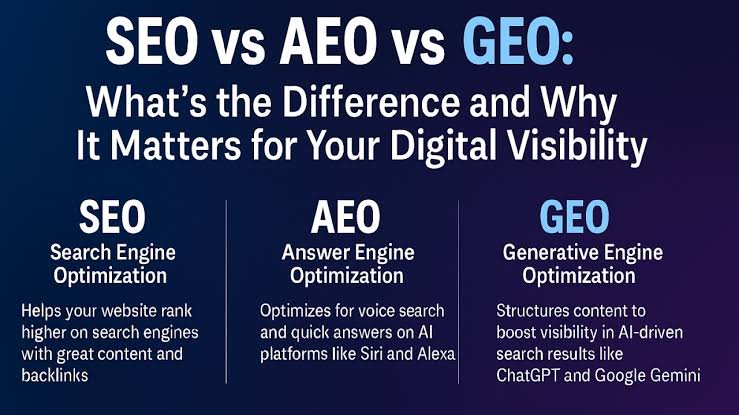
AEO vs GEO vs SEO: What’s the difference? Search Engine Optimization (SEO) no longer just means getting a blue link on a Google results page. As search behavior shifts across different platforms and technologies, new terms have appeared to describe specialized optimization tactics. When you look at AEO, GEO, and LLMO, you might wonder if these are truly new concepts or if they are just subsets of the search optimization work you already do.
Understanding how AEO, GEO, and LLMO function helps you reach your audience where they are actually looking for information. These acronyms represent distinct methods of increasing visibility in modern search environments. By breaking down their specific purposes and how they relate to traditional optimization, you can better plan where to focus your resources for the best results.
Understanding the Search Landscape: Beyond Traditional SEO
Traditional SEO focuses on helping websites rank better in search engines like Google to increase traffic and visibility. It relies on a blend of keyword research, content creation, technical health, and off-page signals like backlinks AEO GEO SEO Difference. The core objective remains consistent: matching user intent with high-quality, relevant content.
What is Search Engine Optimization (SEO)?
At its heart, SEO is the practice of improving your online presence to gain more relevant traffic from search engines. It works by making your content more discoverable and useful for both users and search bots. You achieve this through on-page optimization, which covers title tags and content quality, and off-page factors, which establish your authority. Technical SEO ensures that search engines can find and index your pages without issues.
The Expanding Definition of “Search”
Search has evolved far beyond typing queries into a browser. Users now look for information using voice commands, search for products directly on retail sites, and ask complex questions to conversational AI agents. This change means that a single optimization strategy cannot cover every user interaction. Understanding context, intent, and platform-specific behaviors has become just as important as choosing the right keywords.
Introducing AEO, GEO, and LLMO: A First Look
As search branches out, new terms have arrived to define specialized tactics. AEO, or Amazon Engine Optimization, targets the unique search environment of retail platforms. GEO stands for Geographic Engine Optimization, which addresses the specific needs of local searches. Finally, LLMO, or Large Language Model Optimization, Rank Info Solution helps your content work well within AI-driven conversational search systems.
AEO: Optimizing for Amazon’s Ecosystem
Amazon dominates the e-commerce space, acting as the primary starting point for product discovery for millions of shoppers. AEO is the practice of optimizing your product listings to appear at the top of Amazon’s internal search results. Unlike traditional search engines, where the goal might be informational or educational, the primary intent on Amazon is almost always to make a purchase.
Decoding Amazon Engine Optimization (AEO)
AEO focuses entirely on the Amazon platform. When you optimize for Amazon, you are working with an algorithm that prioritizes sales history, conversion rates, and relevance to specific product queries. Success here depends on how well your listing convinces a user to click and buy, rather than just clicking through to learn more AEO GEO SEO Difference. Effective AEO helps software companies and brands turn search traffic into actual sales pipelines by meeting users right at their point of purchase.
Key Factors for AEO Success
To rank well on Amazon, your strategy must align with the platform’s specific ranking signals. Focus on these areas to improve visibility:
- Product Title and Description: Use relevant search terms that buyers naturally type into the Amazon bar. Focus on clarity and clearly state the main benefits of the product.
- Backend Keywords: Include relevant terms in the hidden search field settings. This helps the algorithm associate your product with those terms without cluttering your public-facing copy.
- Customer Reviews and Ratings: High ratings and recent, positive reviews are major factors. They build trust with buyers and signal quality to the Amazon algorithm.
- Sales Velocity: The algorithm favors products that sell consistently. Higher conversion rates directly lead to better rankings over time.
- Image Quality: Use high-resolution, professional images that show the product from different angles. Clear visuals are crucial for convincing shoppers to purchase.
Is AEO a Form of SEO?
While AEO uses some of the same logic as SEO—like keyword research and optimization—it is distinct. It is platform-specific and driven by an algorithm designed for transactions, not information retrieval. You should think of AEO as a specialized skill set within the broader category of search marketing, rather than a direct translation of traditional SEO.
GEO: Mastering Local Search Visibility
Geographic Engine Optimization, or GEO, is all about connecting a physical business with nearby customers. When someone searches for “coffee shop near me” or “plumber in [city name],” search engines look for local relevance, prominence, and distance.
Understanding Geographic Engine Optimization (GEO)
The goal of GEO is to capture local search traffic by ensuring your business appears in map results and local packs. This is vital for brick-and-mortar stores, AEO GEO SEO Difference service areas, and local professionals. Without a strong GEO strategy, a business might miss out on nearby customers who are ready to visit or call immediately.
Pillars of Effective GEO
Local search success relies on consistent and accurate information across the web. Key tactics include:
- Google Business Profile (GBP) Optimization: Keep your profile verified and up to date. Include accurate business hours, phone numbers, and categories.
- Local Citations and Directories: Ensure your name, address, and phone number (NAP) are identical across all directories and social platforms.
- On-Page Local Signals: Use location-specific keywords in your website content and include local contact information on every page.
- Local Reviews: Actively manage your online reputation. Responding to reviews helps show that your business is engaged and reliable.
- Mobile-First Optimization: Most local searches happen on mobile devices while users are on the move. Your site must be fast and easy to navigate on a phone.
GEO’s Relationship to Traditional SEO
GEO is highly integrated with traditional SEO. You still need a solid, fast-loading website with good content. However, GEO adds a critical layer of location-specific context. Search engines prioritize local results for queries that imply a geographic need, meaning your local SEO efforts often override or AEO GEO SEO Difference supplement your national or global SEO efforts when the user location is known.
LLMO: The Rise of Large Language Model Optimization
As AI tools like ChatGPT, Perplexity, and Gemini become more common, search is changing. LLMO, or Large Language Model Optimization, is the process of structuring your content so that these AI models can easily find, understand, and use your information in their responses.
What is Large Language Model Optimization (LLMO)?
LLMO shifts the focus from ranking on a page to providing concise, accurate, and citable information that AI models can use to construct answers. Instead of trying to get someone to click to your site, you want the AI to “read” your site as a trusted source of information. Google’s guidelines continue to prioritize content quality, emphasizing that traditional best practices for relevance still matter, even in an AI-dominated experience.
Strategies for LLMO
To make your content more accessible and useful to AI models, consider these approaches:
- Content Structure and Clarity: Use clear headings, short paragraphs, and direct language. AI models interpret well-structured text more easily.
- Direct Answers: Incorporate FAQ-style sections that directly address specific questions related to your niche.
- Semantic Understanding: Focus on the intent behind search terms. Write comprehensively about topics rather than just hitting a single keyword.
- E-E-A-T: Emphasize Experience, Expertise, Authoritativeness, and Trustworthiness. AI models are programmed to favor sources with high credibility.
- Structured Data: Use schema markup to help AI tools understand the relationship between different parts of your content.
LLMO: The Future of Search or Just Another Tactic?
LLMO is best viewed as an evolution of content optimization. As AI models become better at synthesizing information, they will increasingly act as the first point of contact for users. Optimizing for these models does not replace SEO, but it changes how you think about “winning” a search. You are now competing to be the source that informs the answer.
Comparing AEO, GEO, and LLMO: Distinct Yet Related
While all three acronyms focus on visibility, we serve different masters and audiences. AEO is about sales on a retail platform, GEO is about physical visits to a business, and LLMO is about being a cited source for AI models.
Core Objectives and Target Audiences
AEO targets shoppers actively looking to purchase products. GEO targets local customers searching for nearby solutions or services. LLMO targets a broader audience that is using AI for research, problem-solving, or general knowledge. The success metrics also differ: AEO tracks conversion and sales, GEO tracks calls and visits, and LLMO looks at visibility and citations within AI responses.
Algorithmic Differences
Amazon uses a proprietary algorithm that heavily weighs past sales data. Google’s local search algorithm prioritizes location signals and user reviews. AI models like those powering LLMO rely on vast datasets and look for accuracy, clarity, and authority. Understanding the specific ranking factors for each environment prevents you from applying the wrong strategy.
Intersections and Synergies
These disciplines often overlap. A strong local reputation (GEO) can provide the trust needed for higher AI-driven visibility (LLMO). Similarly, a highly optimized product listing (AEO) that uses clear, structured information can also perform well when AI models look for product recommendations. Strong content fundamentals—clear writing, authoritative information, and user focus—benefit all three areas.
Do AEO, GEO, and LLMO Constitute “SEO”?
The question of whether these are “SEO” depends on how you define the term. If you see SEO as the practice of optimizing content for search engine discovery, then yes, all of these are forms of search optimization. They are simply adaptations of those core principles applied to specific, non-traditional search platforms.
Platform-Specific Optimization vs. General Search
AEO is clearly distinct because it operates entirely within a closed ecosystem, Amazon. It functions more like merchandising than traditional web search. In contrast, GEO and LLMO are direct evolutions of how we interact with open search engines like Google. They are ways to maintain relevance as the way we browse changes.
The Evolution of Search Optimization
Search is not stagnant. As technology adapts, the way we optimize must also change. While the platforms and algorithms are different, the fundamental goal remains the same: ensuring that when a user searches for something, they find what they need. AEO, GEO, and LLMO are not just buzzwords; they are essential strategies for maintaining presence in a fragmented search environment.
Conclusion: Integrating Diverse Optimization Strategies
Success in search now requires a multi-platform approach. You cannot rely solely on traditional SEO tactics if your customers are looking for you on Amazon, through local map packs, or within AI conversational tools.
Key Takeaways: AEO, GEO, and LLMO Explained
- AEO: Optimizes product listings for visibility and sales within Amazon’s retail platform.
- GEO: Focuses on capturing local search traffic for physical businesses through map and directory optimization.
- LLMO: Structures content to be understandable and citable by AI search engines and chatbots.
Strategic Integration for Digital Success
Prioritize your efforts based on your business goals. An e-commerce brand should heavily invest in AEO, while a local restaurant needs a strong GEO foundation. Every business should incorporate the principles of LLMO into their content strategy to stay relevant as AI continues to change how users find information. By monitoring how your audience searches across these different platforms, you can adjust your tactics to ensure you are always visible.